contact-us

Subscribe by Email

Your email:

Posts by Month

Catalyst Support Blog

Current Articles | RSS Feed RSS Feed

Christy Catalytics' Notes From The 2011 SynGas Association Meeting


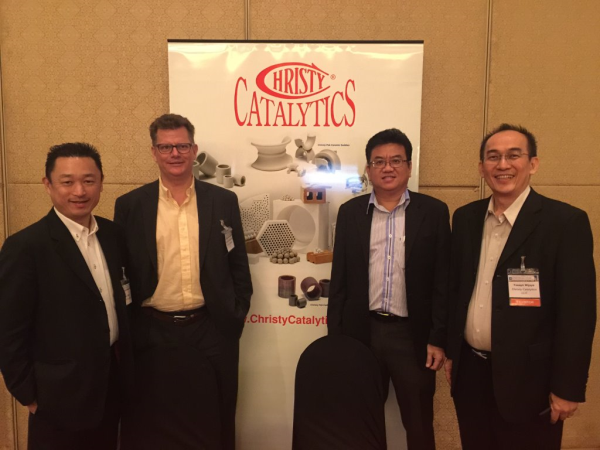
Christy Catalytics held forth at the 2011 SynGas Association meeting in Tulsa, Oklahoma USA from April 25-27. Primarily focused on the ammonia industry, the 375 attendees included delegates from hydrogen facilities as well.

Christy’s exhibit featured its well known PROX-SVERS® inert catalyst bed support media, CUSTOM-CRAFTED™ Hexagonal Target Tile Secondary Reformer toppings, and random packing mass transfer media (saddles, raschig rings, and pall rings).   

Christy Catalytics

www.ChristyCatalytics.com
St. Louis, Missouri  USA

Notes From The Nitrogen + Syngas Conference in Duesseldorf Germany


Christy Catalytics participated in the Nitrogen + Syngas Conference in Duesseldorf Germany from February 20 to 23, 2011.  Organized by the UK-based consultancy CRU (www.crugroup.com), the conference draws attendees from throughout the globe to discuss issues and advancements associated with production and technology of the nitrogen value chain.

Christy’s stand exhibited its comprehensive offerings or high-temperature reactor internals (PROX-SVERS® alumina balls, ceramic balls, and alumina bricks and block), and of mass-transfer media (saddles, raschig rings, and pall rings).   The 2012 conference is planned for Athens, Greece.

Christy Catalytics

www.ChristyCatalytics.com
St. Louis, Missouri  USA

Christy Exhibits at Synthesis Gas Conference in Tulsa, Oklahoma


Christy Catalytics participated and exhibited in the 2010 SynGas Conference in Tulsa, Oklahoma USA on April 19-21.  Over 375 interested parties attended the annual conference and symposium sponsored by the SynGas Association (www.syngasassociation.com) to discuss topics associated with ammonia production.   The meeting also welcomes those from methanol, hydrogen/HYCO, and GTL facilities with similar interests.

2010 SynGas Mtg


Shown in this picture of Christy's exhibit stand are Vernon Christensen (l.), Senior Sales Engineer, and Jim Chwirut (r.), Vice President of Sales and Marketing.  Not pictured: Brian Osborne, President, and Todd Browning, Mid-Continent Sales Engineer.


Featured in Christy's stand were newly introduced mass transfer products such as ceramic and metal saddles, alumina and metal raschig rings, and new low-dP alumina bed support media.  Next year's conference, in April, will again be in Tulsa.

Christy Catalytics

www.ChristyCatalytics.com
St. Louis, Missouri  USA

Catalyst Support Hold Down - Secondary Reformers


Secondary reformer catalyst hold down 

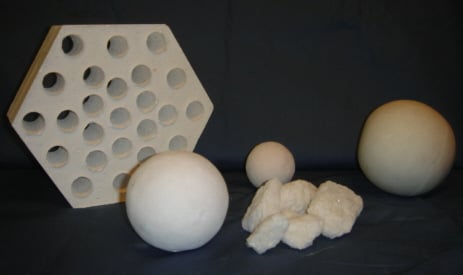
There are several different ways to provide a target and/or catalyst hold down in a secondary reformer. These same methods also apply for synthesis gas high and low temperature shift reactors, although a lower purity material could be substituted to reduce cost. These options are:

Several factors must be considered when selecting catalyst support hold down media:

  • Purity - Low silica is key with >99% alumina being considered the "gold standard".
  • Pressure Drop - Depending upon who you talk to, some insist low pressure drop is important; others insist that a higher pressure drop media is important in order to ensure good flow distribution across the top of the catalyst.
  • Size and Weight - Many secondary reformers have problems with the process gas flow dislocating the catalyst hold down material thus exposing the catalyst bed.  If this is a concern, the heavier the individual media piece, the less likely it is to be displaced during service.
  • Cost - Each of the above options has a different price per installed volume.  Price can be considered once the purity, pressure drop and size considerations have been addressed.

Based on our field experience and conversations with operators, catalyst vendors and engineering design personnel, we believe the following to be true:

  • Alumina lumps have by far the highest pressure drop due to their irregular shape, poor aerodynamic properties and thicker bed volume.  Due to their needle like shape, they have also been known to penetrate into the catalyst bed.
  • 50 mm and 76 mm alumina balls have significantly less pressure drop due to their round surface, consistent void volume and reduced volume required for loading. 76 mm alumina balls have approximately 30% lower dP than 50 mm alumina balls.
  • Hexagonal target tile is a little more difficult to install, but bench scale testing indicates that 64 mm thick hexagonal target tile with 19 mm holes have about half the dP of 76 mm diameter balls.  Due to their weight, they are also the least likely media to become dislocated during unit operation.

While past practice has primarily relied upon the use of alumina lumps and alumina balls, industry trends suggest the use of hexagonal target tile as the product of choice for the toughest applications where dislocation of the catalyst hold down media is a concern.

To ask additional questions or to share your own experiences about difficult catalyst hold down applications, please drop us a line.

Christy Catalytics

www.ChristyCatalytics.com
St. Louis, Missouri  USA
All Posts